Lab Notebook: Seven Experiments Queued Up for the Year (Bring a Raspberry Pi)
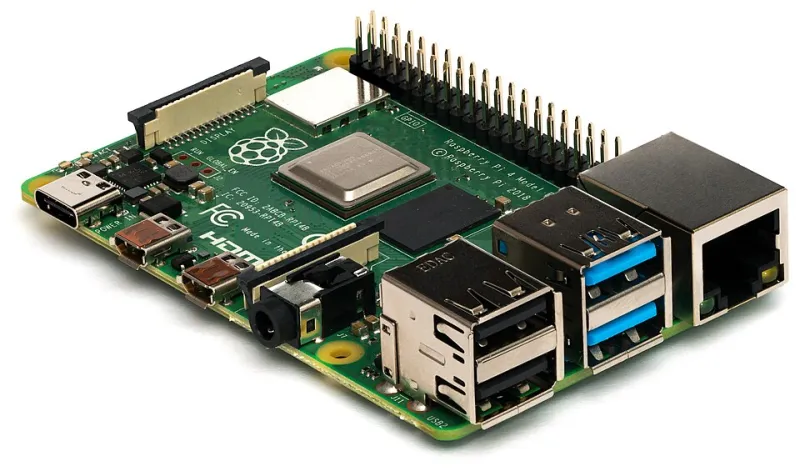
Photo: Laserlicht, CC BY-SA 4.0, via Wikimedia Commons
New year, fresh lab notebook. I sat down in January with a coffee and a blank page and wrote down every experiment I'd been putting off while shipping client work. Seven made the cut. I'm writing them up here the way I'd write them in my actual notebook — hypothesis first, stack second, difficulty last — because if any of you want to race me to a result, that's half the fun.
1. Local LLM on a Mini PC
Hypothesis: A consumer mini PC can run a 7B-parameter model fast enough to replace my ChatGPT habit for drafting and summarization — fully offline.
Stack: A used mini PC with 32GB RAM, Ollama, and Open WebUI on the local network.
Difficulty: ★★☆☆☆
The hardware is the only real cost here. I want hard numbers: tokens per second, and whether I actually notice the quality gap on everyday tasks.
2. Edge-Computed Weather App
Hypothesis: I can build a hyperlocal weather dashboard that renders entirely at the edge, with sub-100ms response times from anywhere in the continental US.
Stack: Cloudflare Workers, Workers KV for caching forecast data, a tiny htmx frontend. No framework. I want to feel the edge.
Difficulty: ★★☆☆☆
The interesting part isn't the weather — it's the cache invalidation strategy. How stale can a forecast be before it's a lie?
3. The $15 Garage Sentinel
Hypothesis: For less than the cost of a pizza, I can build a device that tells me whether my garage door is open — and nags me if it stays open past 10pm.
Stack: Raspberry Pi Zero W (the $15 part), a reed switch from Amazon, MQTT, and a Home Assistant integration.
Difficulty: ★★★☆☆
Yes, commercial sensors exist. No, that's not the point. The point is the reed switch placement, the MQTT reliability, and whether I can keep a Pi alive through a Midwest winter in an unheated garage.
4. Self-Hosted Analytics for This Site
Hypothesis: I can replace third-party analytics with a self-hosted solution that loads in under 50KB and gives me everything I actually look at.
Stack: Umami or Plausible on a $5 VPS, behind Caddy.
Difficulty: ★☆☆☆☆
This one's a warm-up lap. Mostly I want to know how much of my analytics dashboard is vanity.
5. RSS-to-Podcast Pipeline
Hypothesis: I can turn my sprawling RSS backlog into a private podcast feed with decent text-to-speech, so I can consume articles on walks instead of at a desk.
Stack: A Python script, an open-weights TTS model, and a simple static RSS feed generator. Served from the same mini PC as Experiment #1.
Difficulty: ★★★☆☆
The TTS quality is the make-or-break. If it sounds like a robot reading a phone book, the experiment dies on day three.
6. Terminal Dashboard for Everything
Hypothesis: One full-screen terminal dashboard can replace the four browser tabs I keep open for uptime, GitHub notifications, weather, and CI status.
Stack: Rust with ratatui, or Go with Bubble Tea if I chicken out. Data via APIs and webhooks.
Difficulty: ★★★☆☆
The risk here is scope creep — dashboards are a black hole. Hard rule: no new data source until the previous one renders.
7. The Very Dumb IoT Idea: A Fridge that Tweets
Hypothesis: A load sensor under my fridge can estimate how full it is and post a passive-aggressive status to a private channel when I haven't grocery-shopped in a while.
Stack: ESP32, a cheap load cell and HX711 amplifier, and whatever MQTT infrastructure survives Experiment #3.
Difficulty: ★★★★☆
This is objectively the dumbest entry, which is why it's here. Load cells are finicky, weight-to-"how many meals remain" is a nonsense mapping, and I can't wait.
The Rules of the Lab
Three constraints I'm holding myself to: every experiment gets a writeup whether it succeeds or faceplants, nothing gets more than two weekends of effort before I either ship it or kill it, and at least one of these should fail spectacularly — a lab where everything works isn't running real experiments.
Pick one and build along. I'll be posting results in the notebook as they land, and I genuinely want to hear if your version of the Garage Sentinel beats mine.