My Closet Is Now a Hosting Company: The $5 Homelab Experiment, Audited
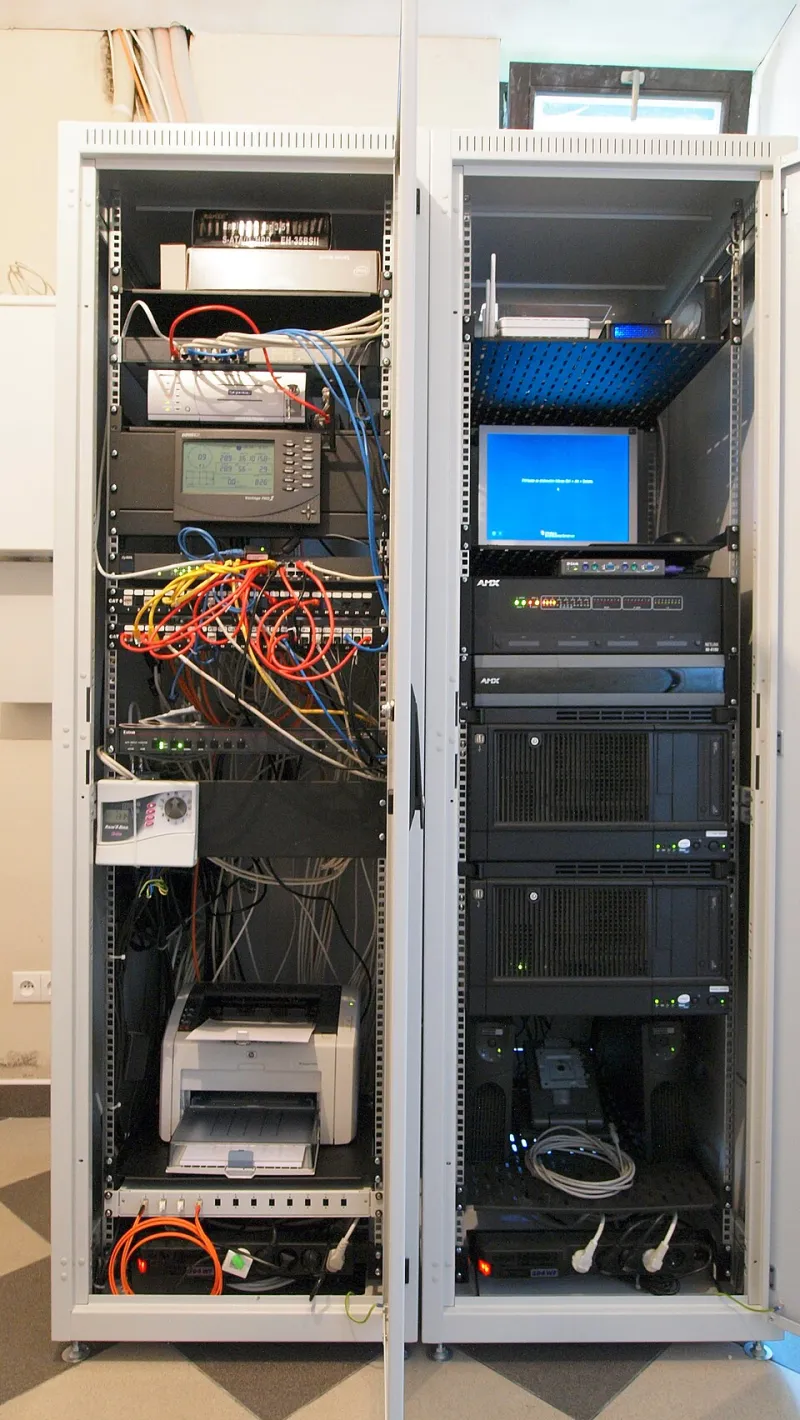
Photo: Jan Prucha, CC BY-SA 3.0, via Wikimedia Commons
There's a moment in every homelabber's life when the rack hums at 30% utilization and you think the dangerous thought: I could sell this.
I had that thought in February. By March, I had a Stripe link, a hand-rolled ToS, and 23 strangers paying me $5 a month to run code on hardware that lives two feet from my winter coats.
This is the audit. What they built, what broke, what it cost, and whether any of it was a business.
The Stack That Runs My Landlord Problem
I didn't want to become a hosting company. I wanted to pretend to become one, which is a different and much cheaper hobby.
The stack, in full:
- Provisioning: A single script that creates a Docker context per user, wired to a Traefik instance with automatic Let's Encrypt certs. Total build time: one very long Saturday.
- Billing: Stripe Checkout plus a webhook that flips a
activeflag in a Postgres row. No trial period. Five dollars, no refunds past 48 hours, because I am one person with a day job. - Limits: 1 vCPU, 1GB RAM, 10GB of storage per subscriber. Enforced with cgroups, mostly. I'll be honest, the disk quotas are enforced with vibes and cron, and one user found that out before I did.
- Terms of service: I wrote it myself in an evening. It contains the sentence "You are renting a corner of a garage in Ohio" and I refuse to remove it.
The whole thing is a micro-PaaS the way a food truck is a restaurant. It works until it rains.
What 23 Strangers Actually Deployed
I expected a bunch of homelab clones and dead landing pages. The reality was weirder.
Six people ran Discord bots. One moderates a 40,000-member server for a game I've never played. Its logs are 90% of my disk I/O and I've made peace with that.
Four ran personal sites, which is the boring, intended use case. Good for them.
Three ran Uptime Kuma instances — people monitoring other people's servers from inside my server. There's a joke in there about turtles all the way down, and I'm too tired to find it.
Two ran web scrapers. One got a politely worded cease-and-desist-adjacent email from a company you've definitely heard of. That was the week I learned my ToS needed a scraping clause.
One person deployed a Minecraft server that immediately blew through its 1GB limit, crashed the node, and took down four other subscribers. He apologized in the shared Discord with a meme, which is the correct amount of remorse.
The rest were experiments in the truest sense: a recipe manager, a fork of some abandoned note-taking app, a "will it run" attempt at some LLM inference that lasted 11 minutes.
The Breakage Report
Here's what actually fell over, in order of pain:
- The noisy neighbor problem is real. One subscriber's cron job fired 400 requests a minute at 3am. My monitoring caught it; my awake-ness did not.
- Backups became non-optional. The moment other people's data touched my disks, "eh, I'll restore from that rsync sometime" stopped being acceptable. I now do nightly snapshots to Backblaze B2. Costs me $2.14 a month and a chunk of my dignity.
- Support is a time sink with no ceiling. Even at 23 users, I got an average of four Discord messages a day. "Is the server down?" at 11pm. "Can I get more RAM?" (No.) "Why is my cert invalid?" (You pointed DNS at the wrong record, Kevin.)
- One power outage. Fourteen minutes of downtime. My status page — the one with attitude, from a previous experiment — roasted me in real time. My subscribers loved it. I did not.
The Money Math, Unvarnished
Revenue: 23 × $5 = $115/month.
Costs: power ($18), the B2 backups ($2.14), a domain for the platform ($1.50 amortized), and Stripe's cut ($4). Call it $26 all-in, not counting the roughly $900 of hardware I already owned and had written off as a sunk cost the day I bought it.
So yes, it's profitable on a cash basis. It is wildly unprofitable once you price my time at anything above zero. At four Discord messages a day plus maintenance, I estimate I earn about $2.10 an hour, which is below the tipped minimum wage in most states and I don't even get tips.
The Part I Didn't Expect: It Became a Place
Here's the thing I got wrong, and it's the reason I haven't shut it down.
The shared Discord turned into an actual community. Subscribers help each other debug Dockerfiles. The Minecraft guy now contributes fixes to my provisioning script. Someone made a bot that posts my server temps every morning, which is either delightful or surveillance, depending on my mood.
Two of them have hired me for freelance work. One talked me through a Kubernetes problem at midnight because he happened to be awake and happened to care. You cannot invoice for that.
So Is It a Business?
No. It's a membership. Nobody's paying $5 for the compute — you can get a far better VPS from any number of providers for the same money, and I tell them that in the welcome email. What they're paying for is proximity: a shared closet, a human on the other end, a little lab they get to be weird in.
That reframing changed my ToS, my roadmap, and my stress level. I'm not competing with DigitalOcean. I'm running a very small, very strange club with a server in it.
Would I recommend this? Only if you like people more than you like uptime. My uptime is 99.4%. My community retention is 100% — nobody has churned since month two.
The rack's still humming. Twenty-three people are depending on it. My coats smell like exhaust.
Worth it. Barely. Ask me again in Q3.